



Aydınlatma metni yükleniyor…
Website maintenance and ongoing SEO are not the same service. Maintenance is primarily concerned with keeping a website current, secure, functional and manageable. SEO focuses on understanding search demand, improving the relevance and structure of pages, planning content and measuring organic search performance over time.
The two areas are not completely separate. Broken links, incorrect redirects, canonical errors, indexing blocks, slow pages and mobile issues can affect both technical operations and search visibility. That overlap does not automatically turn a maintenance plan into a complete SEO programme. The distinction should be based on the purpose, scope, frequency, deliverable, owner and success measure of each task—not on the label used in a proposal.
This guide provides a practical way to divide a proposal into three areas: technical maintenance, shared technical SEO hygiene and ongoing SEO.
Why Website Maintenance and SEO Are Often Confused
The same technical issue can produce different consequences. A broken link may interrupt a visitor’s journey, create extra operational work and make it harder for crawlers to discover the intended page. A slow page can be investigated as a user-facing technical problem and as part of a wider search performance review. An incorrect canonical is directly relevant to search, yet fixing it may require a change in the website’s code or content management configuration.
That is why neither of these shortcuts is reliable: “If it is technical, it belongs to maintenance” or “If it affects Google, it belongs to SEO.” A single issue may create two separate responsibilities:
- Detection and continuity: Identify the fault, assess its operational impact and create the appropriate technical task.
- Analysis and optimisation: Investigate the cause, search intent, target page and relationship with other URLs before deciding on a lasting improvement.
In Kumsal Ajans’s confirmed service model, detecting technical faults may fall within maintenance. In-depth optimisation and continuous improvement belong to a separate SEO service. If that boundary is not written down, the client and provider can assign very different meanings to the same phrase, such as “SEO checks included.”
A Three-Zone Website Maintenance and SEO Scope Matrix
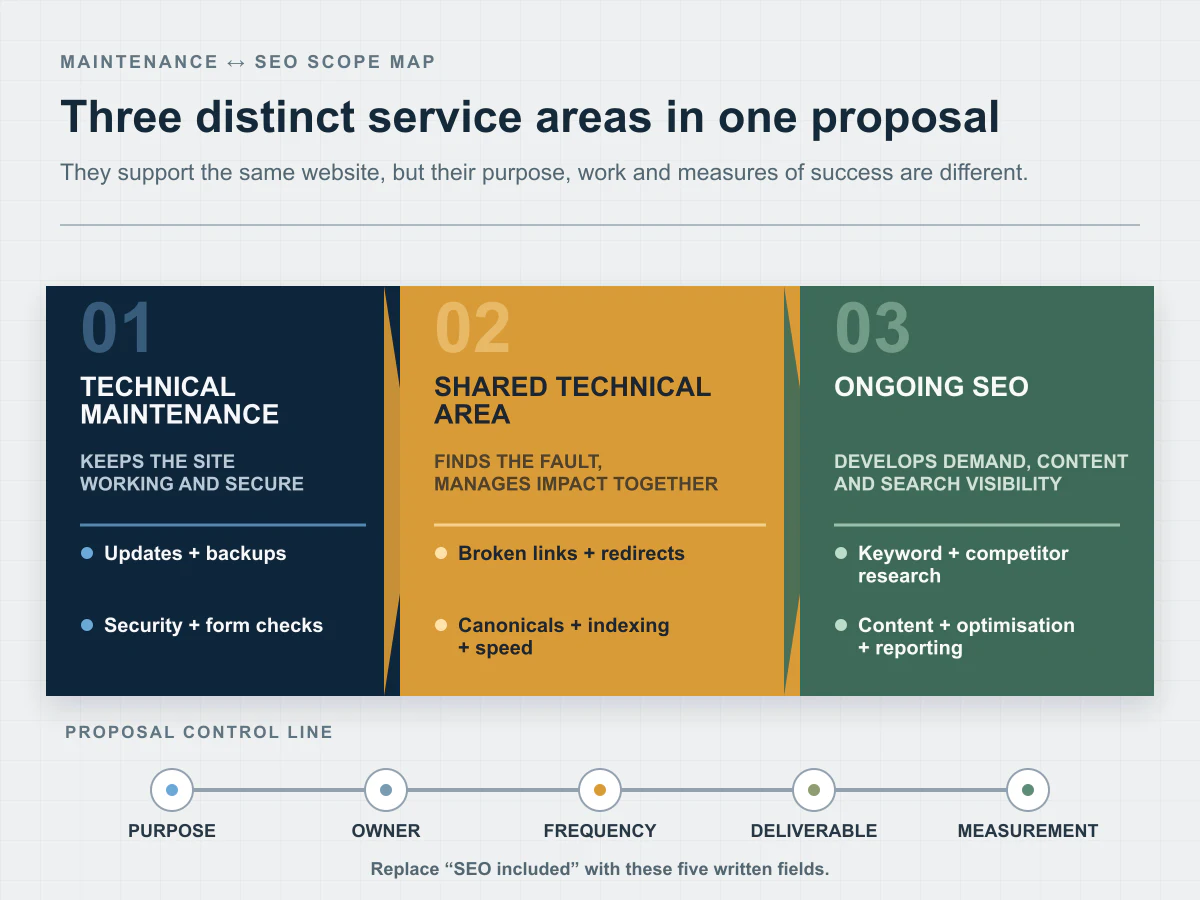
The matrix below is a starting point. The final boundary must be documented according to the platform, contract, impact of the issue and amount of work required.
| Task or need | Role of technical maintenance | Role of ongoing SEO | Expected record or deliverable |
|---|---|---|---|
| Software and system updates | Check the need for an update, assess compatibility and perform the agreed release | Monitor search-related effects when the update changes crawlability, rendering or page behaviour | Update and verification record |
| Backups and recovery preparation | Manage file and database backups according to scope | Not an SEO strategy task in itself | Backup or recovery record |
| Security and error monitoring | Monitor security, access and technical errors | Review relevant search reports if visibility is affected | Incident and action record |
| Form checks | Confirm that submission and delivery work end to end | Evaluate organic landing-page and conversion context separately | Test result and error record |
| Broken links | Detect broken URLs | Choose and prioritise the right destination based on page purpose and internal-link structure | Broken-link list and action decision |
| 301 redirects | Confirm that an existing redirect works | Map old and new URLs and review content equivalence and signal consistency | Redirect map |
| Sitemap and robots.txt | Confirm availability and detect obvious technical errors | Align crawl and index decisions with the intended search strategy | Technical check and scope recommendation |
| Canonical tags | Detect missing, malformed or unexpected values | Decide which URL should be preferred among similar pages | Canonical review |
| Speed and mobile issues | Identify visible functional or layout problems | Measure, prioritise and manage ongoing optimisation | Measurement, task and retest record |
| Keyword and competitor research | Not a maintenance task | Research demand, result types and page opportunities | Research and priority plan |
| Content planning and production | Provide publishing support only when specifically included | Plan topics, pages, queries, production and optimisation | Content calendar and page brief |
| SEO reporting | Share relevant maintenance records | Interpret queries, pages, visibility, clicks and business outcomes | Periodic SEO report |
Two teams appearing in the same row does not mean that the task should be duplicated. It means that technical continuity and search strategy ask different questions and need a clear handover.
What Is the Purpose of Annual Website Maintenance?
Annual maintenance is designed to keep the live website technically manageable throughout its operating life. Depending on the agreed project scope, Kumsal Ajans maintenance work may include:
- software and system updates,
- file and database backup processes,
- security and access checks,
- verification of website forms,
- investigation of error logs,
- baseline performance checks.
This list should not be interpreted as a fixed package delivered at the same frequency for every website. A corporate brochure site, a custom platform with frequent transactions and an ecommerce system do not have the same risks. The maintenance proposal should define the frequency, owner, intervention boundary and reporting format that apply to the actual project.
Maintenance protects the operation of the current system. A new module, major design change, new user journey or extensive integration will usually require separate development scope. For a fuller explanation of that boundary, see our guide to free support and ongoing website maintenance.
What Is the Purpose of Ongoing SEO?
Ongoing SEO is not limited to finding technical errors. It examines what potential customers search for, whether existing pages satisfy that need, which pages should be created or improved and how completed work relates to search performance and business outcomes.
Within Kumsal Ajans’s confirmed SEO service model, the following activities are delivered as separate, recurring work:
- keyword and search-intent research,
- competitor and search-result analysis,
- page and content planning,
- content production,
- page-level optimisation,
- SEO measurement and reporting.
Google’s Search guide for developers covers technical foundations such as crawlable links, sitemaps and websites that are secure, fast and work on mobile devices. It also directs readers to broader SEO guidance that includes non-technical work such as creating content. The distinction is useful: technical foundations matter, but they do not represent the whole of an ongoing SEO strategy.
When assessing an SEO service, review not only the list of actions but also the research method, deliverables, prioritisation and reporting. Our guide to choosing and evaluating an SEO service provides a complementary set of questions.
Where Does a Baseline Technical SEO Check End?
A maintenance plan may check the sitemap, robots.txt, broken links, redirects, canonical tags and technical faults that affect indexing. The phrase “checked” still needs a precise definition.
For example, receiving a 200 response from the sitemap does not prove that every listed URL is correct or eligible for indexing. Google’s sitemap documentation explains that a sitemap can help search engines discover URLs, but does not guarantee that every item will be crawled or indexed.
Likewise, confirming that a 301 redirect returns the expected status code is not the same as confirming that it points to the right page. Google’s redirect guidance describes a permanent redirect as a signal that the destination should be treated as canonical. The destination therefore needs to be selected according to the meaning and purpose of the former page, not simply technical convenience.
The presence of a canonical tag is also not sufficient on its own. Google’s canonical guidance recommends avoiding conflicting canonical targets across different methods, linking internally to the preferred canonical URL and using a self-referencing canonical on the canonical page.
In these examples, maintenance can identify and record an absent or unexpected technical value. Deciding which URL should be kept, consolidated, redirected or repositioned may require deeper analysis and ongoing SEO work.
How to Clarify “SEO Included” in a Proposal
“SEO included” is not a measurable service definition by itself. Ask for the following seven fields to be completed in the proposal or service plan:
- Purpose: Is the aim technical continuity, visibility research, content growth or something else?
- Scope: Which pages, languages, systems and data sources are included?
- Owner: Who detects the issue, implements the change, prepares content and performs the final check?
- Frequency: Is the work one-off, incident-based or recurring?
- Deliverable: Will the client receive an error list, redirect map, content brief, implementation record or performance report?
- Approval: Who approves technical changes and content publication?
- Success measure: Is completion measured by resolving a fault, implementing agreed work, a visibility trend or a business outcome?
Without these fields, the provider may understand “SEO included” as a short technical review while the client expects keyword research, regular content production and a complete SEO programme.
Who Prepares and Approves Content?
In Kumsal Ajans projects, content can be prepared by the agency or the client according to the agreed scope. Regular content production should not be assumed to be part of maintenance unless it is explicitly included in the proposal.
Regardless of who writes the first version, factual accuracy, brand language, legal statements and the final publication decision are completed with client approval. An agency may provide technical and editorial recommendations, but it should not invent unverified product, price, commitment or company claims on the client’s behalf.
How Should Results Be Measured Without Guarantees?
Kumsal Ajans does not guarantee a specific ranking, traffic level or performance score through maintenance or SEO services. Work is planned around verifiable actions and measurable improvement objectives instead.
On the maintenance side, measurement may include confirming that an update was applied, a form works from submission to delivery, an error was resolved or the agreed backup process was verified. On the SEO side, measurement may consider queries, impressions, clicks, landing pages, organic user behaviour and relevant business outcomes.
Google’s guide to Search Console and Analytics data explains that Search Console shows data about performance in Google Search, including impressions, clicks and queries, while Analytics helps evaluate what users do after they reach the site. The figures from the two systems are not expected to match exactly because they measure different interactions.
A single performance-test score should not be treated as the complete user experience either. The web.dev Core Web Vitals workflow distinguishes diagnostic laboratory tests from field data that reflects real user experiences. A useful performance plan should therefore record the measurement method, starting point, implemented change and retest instead of promising one permanent score.
What Happens When an Issue Affects Both Maintenance and SEO?
When one issue crosses both areas, a shared record can prevent conflicting instructions:
- Define the technical fault and its user impact.
- Assess the potential search visibility impact separately.
- Assign responsibilities between the maintenance and SEO teams.
- Identify any content, URL or implementation decisions that require client approval.
- Complete the technical change and SEO validation, then report the outcome in one place.
An incorrect canonical value, for example, may be detected during maintenance. The technical team can investigate where the value is generated, while the SEO team confirms the correct target and its consistency with other signals. The client approves any decision that materially changes URLs or content. This makes ownership visible without forcing the issue into only one department.
Anonymous Example: When Content Production Was Assumed to Be Maintenance
In one project, the client understood regular content production to be part of annual website maintenance. The scope of technical maintenance and active SEO work was clarified, and the service process was replanned.
The issue was not simply that one party was right and the other was wrong. The word “update” could refer to a software update, a small correction to existing copy or the research and production of new content on a recurring basis. Once the scope was documented, technical maintenance and SEO work involving research, planning, production, optimisation and reporting could be assigned to the correct owners and deliverables.
The client, industry, dates, content volume and outcome data have been omitted to preserve anonymity.
A Checklist for Comparing Maintenance and SEO Proposals
Before accepting a proposal, request written answers to these questions:
- Which updates, backups, security, form and error checks are included?
- How frequently are checks performed, or what event triggers them?
- For broken links and redirects, is the scope limited to detection or does it include correction and URL mapping?
- What deliverables are provided for sitemaps, robots.txt, canonical tags and indexing issues?
- Which data source is used for speed and mobile checks?
- Are keyword and competitor research included separately?
- Who prepares the content plan and copy?
- How many pages and which elements are included in page optimisation?
- Who checks the English version after Turkish content changes?
- How do technical and SEO teams share responsibility for a cross-functional issue?
- Will the client receive an error list, an implementation record or an SEO performance report?
- Which operational and organic indicators are used to evaluate results?
- How are excluded tasks and new development requests scoped and priced?
- Which realistic objectives replace ranking, traffic or score guarantees?
Conclusion: Compare Tasks and Deliverables, Not Service Labels
Website maintenance and ongoing SEO can support each other, but neither replaces the other. Maintenance protects technical continuity. SEO examines search demand, page and content opportunities, technical priorities and organic performance over time. Sitemaps, redirects, canonical tags, speed and mobile issues may sit in the overlap, so detection, decision-making, implementation and reporting responsibilities need to be stated clearly.
Do not rely on the words “maintenance” or “SEO included” alone. Document the purpose, scope, owner, frequency, deliverable, approval and success measure. This makes it possible to budget for technical continuity and search growth with realistic expectations.
Frequently Asked Questions
Does a website maintenance plan replace an SEO service?
No. A maintenance plan may check the sitemap, robots.txt, broken links, redirects, canonical tags and technical faults that affect indexing. Keyword research, competitor analysis, content planning, production, page optimisation and recurring SEO reporting belong to a separate SEO service.
Is fixing broken links a maintenance or SEO task?
Detecting a broken link and correcting an obvious technical fault may fall within maintenance. Choosing the right destination, redesigning internal links or prioritising a large set of pages may require broader SEO analysis. The exact boundary should be stated in the proposal.
Does checking a sitemap mean that SEO work has been completed?
No. Confirming availability and obvious errors is a technical check. Deciding which URLs belong in the sitemap, checking consistency with canonical and indexing decisions and monitoring search performance are part of a wider SEO process. A sitemap does not guarantee indexing.
Is regular content production included in website maintenance?
Only when it is explicitly included in the proposal or service plan. In Kumsal Ajans projects, content may be prepared by the agency or client according to scope, and final publication approval comes from the client. A recurring programme that requires research, planning and production is scoped as a separate SEO service.
Does Kumsal Ajans guarantee rankings or traffic through SEO?
No. Kumsal Ajans does not guarantee a particular ranking, traffic level or performance score. Work is planned around verifiable tasks, suitable data sources and measurable improvement objectives. Search performance and on-site behaviour are evaluated using the appropriate reports rather than a single metric.